ZYSKORO / RESEARCH DESK
What to do after a suspicious investment payment
Make a redacted chronology before contacting a recovery offer
Act promptly, preserve evidence and use official channels. Recovery depends on the facts and payment method.
Secure what you can
Stop sending additional money, including supposed “unlock” or “tax” payments. Change passwords for accounts you shared and enable multifactor authentication. If you installed remote-access software at someone's request, seek trusted technical help to remove it safely.
Create an evidence file
Save the URL, legal names used, messages, payment receipts, transaction IDs, dates and screenshots of the exact claims. Write a chronology while details are fresh. Keep originals; do not alter receipts or message metadata.
Contact the payment provider and regulator
Tell your bank, card issuer or exchange immediately and ask what dispute or recall options exist for that particular transfer. Report the offer to your national financial regulator or law enforcement. In the UK, the FCA Warning List explains how to report suspected unauthorised firms; in the US, Investor.gov points to reporting routes.
Watch for recovery pitches
Anyone who claims they can guarantee recovery in exchange for a new upfront fee should be independently verified. Share sensitive documents only through official channels you located yourself.
Make a redacted chronology before contacting a recovery offer
A clear chronology helps an official recipient understand a report. It also lets you keep originals separate from a summary you can share. A polished recovery website is not proof that its operator is entitled to handle your case.
A fictional evidence index
| Sequence | What happened | Original retained privately | Safe summary |
|---|---|---|---|
| 1 · Monday, 09:00 UTC | Offer received | Message export and claimed URL | Claimed service and amount requested |
| 2 · Monday, 10:15 UTC | Payment sent | Provider receipt and transaction reference | Method, amount, date; reference available through official channel |
| 3 · Tuesday, 14:00 UTC | Extra “release fee” requested | Exact message and sender details | New demand recorded; no additional payment |
Prepare the first official contact
- Locate your payment provider’s support route independently, using its established website or app. Do not follow a link supplied by the person asking for more money.
- Explain the sequence, amount, method and current status. Ask what recall, dispute or reporting options apply to this particular transaction.
- Use the official channel’s requested format for sensitive references. Do not publish account numbers, identity documents, passwords or complete receipts in a public post.
- Save the case reference and requested next step. Keep the original evidence unchanged and mark corrections in your summary.
The FCA warns about recovery-room approaches that seek another upfront payment and about clone firms copying real registration details. Check the provider and the permission for its actual service through the relevant regulator, using the regulator’s contact details. The UK guidance is jurisdiction-specific; readers elsewhere need their own regulator and payment-provider routes.
There is no recovery guarantee here and no universal deadline or entitlement asserted for every payment method. If technical compromise is suspected, secure the affected accounts through their genuine support channels. This resource does not accept private case files; the worksheet is an offline preparation aid.
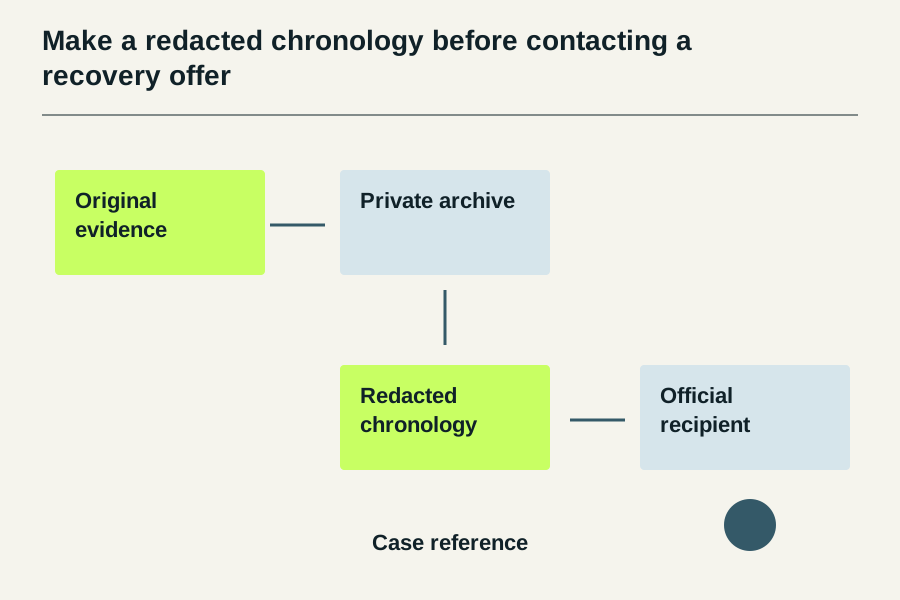
Steps: Original evidence → Private archive → Redacted chronology → Official recipient → Case reference.
Download the working card ↓Written by Zyskoro Research Desk. Source: FCA · Recovery room scams.