ZYSKORO / RESEARCH DESK
Read the fees and withdrawal terms
The investment story is incomplete until you know what you would pay and how you could get your money back.
Ask for the full cost schedule
Request opening, transaction, management, performance, conversion, inactivity, withdrawal and closing charges in writing. Ask when each is taken and whether a fee applies even if the investment loses value. The SEC explains how fees reduce returns over time.
Identify custody and the payee
Who legally holds the asset? Which institution holds cash? Does the beneficiary name match the regulated entity or a documented custodian? Keep the payment instruction and the firm’s written explanation together. A discrepancy is a question to resolve before a transfer.
Read the exit path
Look for notice periods, lockups, redemption limits, minimum balances, tax handling and the method used to calculate the withdrawal amount. Ask for a worked example with the same amount and currency you would use; mark every fee and possible delay. Do not assume “withdraw anytime” in an advert overrides the contract.
A one-page comparison
Make a table with rows for initial payment, annual cost, transaction cost, conversion cost, withdrawal fee, custodian, withdrawal timing and worst-case loss. Fill every cell from written product documents. Leave unknown cells visible rather than guessing.
Turn a withdrawal promise into questions the contract can answer
“Withdraw anytime” can refer to making a request, not receiving cleared money. Before a deposit, separate the request route, notice period, eligibility conditions, fees, calculation basis and settlement timing. This exercise reads documents; it does not test a provider, recommend an investment or establish that funds can be recovered.
Follow one amount through the wording
Choose an illustrative amount and currency. Record the document version and the exact clause reference privately. Ask when the request is accepted, when the asset is valued and when money is expected to reach the receiving account. These may be different dates. If a term says “normally”, preserve that qualification and ask what exceptions apply.
A deliberately incomplete fictional clause
Suppose a teaching document allows a request for 200 units after a 30-day lockup, requires five business days’ notice, and states a fee of 2 units. It does not state a settlement deadline or define the valuation date. You can record the lockup, notice and stated fee. You cannot convert them into a confirmed date of payment. The example is invented and contains no actual provider or product.
If the amount being redeemed were fixed at 200 and the only deduction were the stated fee of 2, the arithmetic amount would be 198. That conditional calculation is not a promised payout: valuation, tax, conversion and any other deductions remain unresolved. Do not replace these unknowns with zero. Ask for a written worked example using the same currency and amount.
Complete the exit record
- Request: record the official channel and who accepts the instruction.
- Eligibility: identify the lockup, minimum balance and any redemption limits.
- Timing: separate notice, valuation and settlement; record how business days are defined.
- Cost: list the fee and its denominator, minimum or fixed amount.
- Destination: verify custody, the payee and the receiving-account rules.
- Unresolved conditions: ask the independently verified firm to explain them in writing before a deposit.
A copied contract or licence number does not establish that a message came from the firm. Use contact details independently obtained from the regulator’s record. If a new payment is demanded to “unlock” a withdrawal, pause and seek independent guidance; do not accept the demand merely because the sender quotes the earlier document.
Keep the original clause, your dated questions and the response privately. The FCA register provides context for checking the entity and permissions; it does not validate this hypothetical clause or guarantee a withdrawal. A completed worksheet is evidence of questions asked, not a safety score.
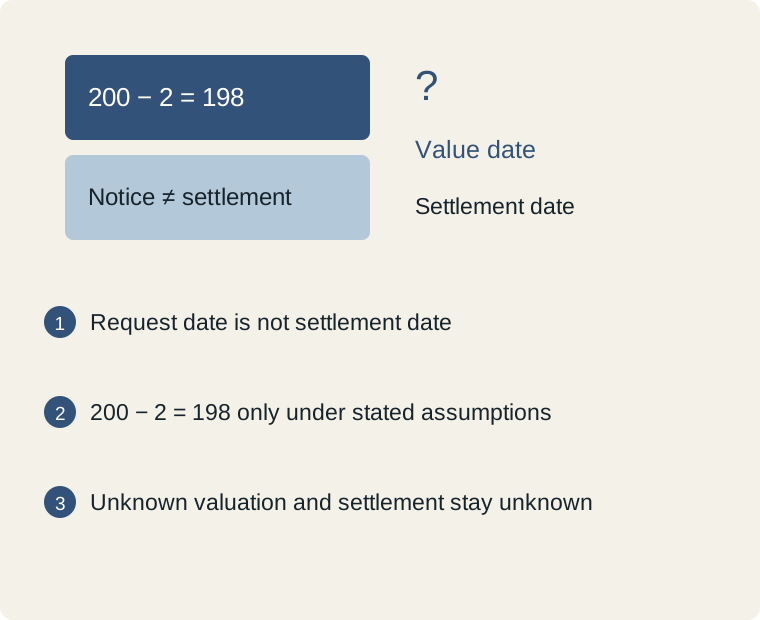
Steps: Request date is not settlement date → 200 − 2 = 198 only under stated assumptions → Unknown valuation and settlement stay unknown
| Field | Completed example |
|---|---|
| Document and request route | Fictional teaching clause; route to confirm |
| Eligibility | 30-day lockup (fictional) |
| Notice definition | Five business days; calendar definition unknown |
| Stated fee | 2 units, fixed teaching assumption |
| Conditional arithmetic | 200 − 2 = 198 if no other deduction |
| Valuation / settlement uncertainties | Both unspecified; request written clarification |
Blank worksheet and worked example ↓
Primary context: FCA: independently check the firm
A spread is a cost even when the commission is zero
Separate the price difference from the fee charged on a statement. This fictional one-unit round trip keeps the arithmetic visible; it is not an investment recommendation, a live quote or an estimate of what an actual platform will execute.
- Record bid and ask at the same instant, in the same currency, for the same instrument and quantity. The ask is the offered selling price; the bid is the offered buying price. Do not compare two screenshots taken at different times and call the difference the spread.
- List explicit charges separately: buy fee, sell fee, conversion, custody and withdrawal where applicable. Write “unknown” rather than zero when a tariff has not been checked.
- Work through the cash ledger. With ask 100, bid 99 and a fee of 2 on each side, buying one unit uses 102. Selling it at the unchanged bid returns 97 after the second fee. The difference is 5: one of spread plus four of explicit fees.
- Test what the displayed quote does not prove: available size, slippage, minimum charges and execution timing. Request the applicable schedule before funding an account; a “zero commission” label does not settle these questions.
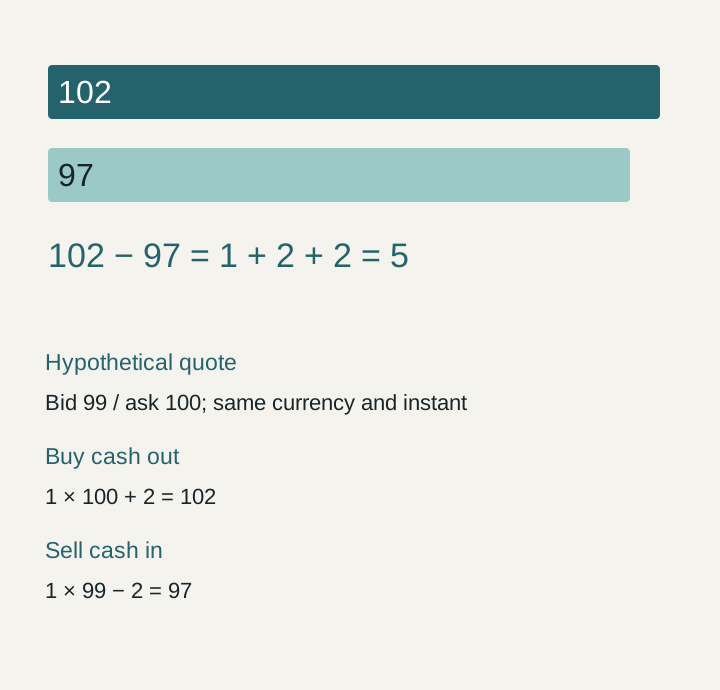
Diagram text: Hypothetical quote: Bid 99 / ask 100; same currency and instant; Buy cash out: 1 × 100 + 2 = 102; Sell cash in: 1 × 99 − 2 = 97
| Field | Example or check |
|---|---|
| Hypothetical quote | Bid 99 / ask 100; same currency and instant |
| Buy cash out | 1 × 100 + 2 = 102 |
| Sell cash in | 1 × 99 − 2 = 97 |
| Round-trip difference | 102 − 97 = 5 = 1 spread + 4 fees |
| Zero-fee counterexample | 102 and 97 no longer apply: with both fees zero, cash out 100 and cash in 99; difference 1 |
| Not included | Market movement, slippage, tax, conversion, withdrawal and custody. Check each separately. |
A percentage needs a denominator: 5 divided by the 102 cash outlay is about 4.90%, whereas 5 divided by 100 is 5%. Label which you use. This comparison does not establish that an offer is legitimate or that a withdrawal will be honoured. Keep identity, custody and withdrawal verification as separate checks.
Read the clock behind an inactivity fee
An inactivity charge needs a trigger and a charging rule before it can be calculated. Do not assume that opening an app, holding an asset or sending a message resets the clock. Obtain the applicable dated terms and ask which action counts. The SEC’s fee bulletin identifies account inactivity as a possible brokerage charge and recommends checking fee disclosures and statements.
- Copy the exact definition of inactivity, the date of the last qualifying action and when a charge first becomes due. Preserve whether the period uses calendar months, days or another convention.
- Identify the amount, currency, recurring interval, maximum charge or balance limitation, and any exemptions. Record missing terms as unknown.
- Work through one complete interval by hand. Then test a boundary: an action near the cut-off, a partial month or a balance smaller than the stated charge. Request clarification rather than inventing the provider’s rounding or debit rule.
- Compare the written rule with a dated statement. Ask about an unexplained deduction through the independently verified firm’s contact route. Do not make an unnecessary trade simply to satisfy an unverified message.
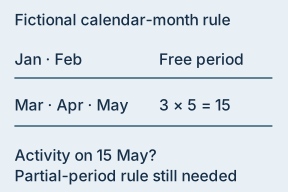
Invented tariff for an arithmetic exercise: suppose terms state that two completed inactive calendar months are free, followed by a fixed charge of 5 units for each completed inactive calendar month. The account has no qualifying activity throughout January to May. January and February are the free months; March, April and May produce 3 × 5 = 15 units. This is not Zyskoro’s tariff or an actual firm’s offer.
If those fictional terms do not explain what happens after activity on 15 May, the May charge is unresolved. Do not automatically count half of 5 units or assume the whole month is waived. Likewise, a balance of 3 units does not tell you whether a 5-unit charge is capped, carried forward or treated another way. Those rules must come from the actual terms.
Cost record: entity/product ___; fee-schedule date ___; qualifying activity definition ___; last qualifying event ___; free period ___; charge interval ___; fixed/percentage amount and basis ___; caps/exemptions ___; boundary case ___; written answer ___; statement comparison ___. This is document-reading practice, not a recommendation to invest, trade, leave money with a firm or expect a particular withdrawal outcome.
SEC Investor Bulletin, 23 July 2025: fees, account inactivity and disclosure questions